Showing posts with label japan. Show all posts

4.05.2014

Henri Charpentier

mmm


Tokyo is filled with many French-inspired Japanese desserts, or perhaps I should it's Japanese-inspired French desserts. Japanese pastry chefs have a special way of incorporating French techniques into Japanese desserts while making tweaks and adjustments to suit the local palate. Even after this sort of cultural amalgamation in the different world of desserts, the resulting taste is not compromised but brought to perfection. In fact, the Japanese is known for their traits in perfecting a task that they are to execute.

At Henri Charpentier, the Japanese-French dessert salon is located in the basement which makes a fabulous spot to getaway from shopping in the luxury shopping area in Ginza. The walk on the stairs is surrounded by a wall made to look like a cookbook library with layers of shelves filled with recipe books and pink hardcover books.


The crepe suzette here stands out in the way it's prepared table side. The server wheels a cart to our table with prep materials for the crepe. The crepe itself is made in the kitchen first but flambeed table side. First, the orange caramel sauce is poured into the saucepan with the crepe. The server uses a spoon and continuously makes sure that the caramel sauce is all over the delicate crepe.


She opens the bottle of Grand Marnier, pours the orange liqueur into a glass, and carefully tilts the glass over the open flame. She then skillfully and gently swirls the glass in a rhythmic fashion over the flame. The liqueur slightly lights up and is poured over the crepe leaving to simmer until the sauce further caramelizes and thickens.


There is no table side showtime for the other item of chocolate crepe with chocolate coffee cream and it turns out to be our favorite among the two items. The level of chocolate is perfect without being too intense or rich; the preserved orange slices add a nice touch to the overall chocolatey-ness of the dessert. We are fans, for sure.


--
Henri Charpentier
3-6-1 Ginza,  
Chuo, Tokyo


4.04.2014

Nagi Ramen Golden Gai


We walk along the very narrow alleyways of Golden Gai in Shinjuku, Tokyo looking for Nagi Ramen until we recognize the signage.  A young male employee in a Barbour jacket is standing at the entrance of the narrow stairs that lead to the ramen shop upstairs. I say to him "ramen?" and he asks if we speak Japanese. T tells him "sukoshi." He then tells us to please head upstairs to buy our ramen tickets first and then gestures us to join the line of customers after purchasing the tickets. We look in the direction of his hand gesture and see what we did not even realize before: a line of customers standing in a very dim alleyway so narrow that it only has space for a single line. The existence of the alleyway is not intentional; it happens to be a tight space between two buildings.

We walk up the rickety and narrow stairs to the ramen shop, each step of the stairs is not wide enough to rest the entire foot on. We get to the top and buy our ramen tickets from the vending machine (it is common practice to "order" and pay for your ramen through a vending machine so that the chef does not have to handle change). Then we walk down the stairs and join the line in the alleyway.


About 30 minutes later, the young man standing by the stairs gestures us upstairs to get seated. Ramen shops in Tokyo are generally tight spaced and Nagi Ramen is literally a hole in the wall. We have no complains, it adds to better socializing atmosphere for us at this 10-seater ramen shop. Once we're seated, we don't even think about moving about. We are there just to enjoy the ramen moment


Nagi Ramen specializes in tonkotsu broth flavored with sardines. The broth is pungent and the sardines flavor is strong. The taste is unlike anything we've had before. We've had quite a lot of tonkotsu ramen but when pork bones and sardines come together in the Nagi way, it transforms the broth to a whole new flavor. Behind the counter are two employees; one prepares the ramen and the other serves the ramen over the counter.

Preparing ramen has to be precise. For each batch, the noodles are placed on a weighing scale to get the right amount of noodles. Then, the noodles are placed in boiling water and the timer starts. Having the right amount of noodle with the right cooking time ensures consistency in reaching the ideal noodle texture. We get the special niboshi ramen and the tsukemen (dipping ramen). The noodle has an addictive chewy texture that shows that the noodle is freshly made. Each bowl has a few sheets of thin and slightly wide "noodle" that is very reminiscent of gyoza skin which I like very much. The pungent broth makes it the most memorable ramen we've had, and probably one of the best we've had.


One of the employees behind the counter asks if we are in Tokyo for vacation. He then says to us, "Working?" (at least he didn't mistake us for being students). We tell him yes, and he makes a guess and says "Engineer?" A wild guess definitely but far from accurate. We tell him it's our second time in Tokyo and the city is tanoshii. He smiles and agrees with us. I point to my bowl of my ramen and say "Best." He nods happily and the other employee preparing the ramen overhears and smiles to himself.


We are more than satisfied after our meal and as we carefully walk down the narrow stairs, the employee who is still supervising the line downstairs surprises us by saying "Take care."


--
Nagi Ramen
Shinjuku Golden-gai (G2 street) 2F, 1-1-10, Kabukicho
Shinjuku-ku,Tokyo


3.23.2014

High Five Bar


T and I have social media to thank for discovering High Five Bar in Tokyo, owned by the world renowned bartender Hidetsugu Ueno. Given that T and I are huge fans of Brendan Sodikoff's restaurants in Chicago (Bavettes Bar and Boeuf, Maude's Liquor Bar, Gilt Bar), we trust the taste of Chicago's known restaurateur. In an interview with him on Eater Chicago, Sodikoff mentions High Five Bar as one of his favorite bars in Tokyo and even going so far as to naming his upcoming ramen joint in Chicago after this bar. Another random time as I browse my Twitter feed, I see a tweet from Grant Achatz (of Chicago's Alinea and Next) that he is at High Five Bar during his trip there. A quick online search reveals the bar's reputation.

Ueno-san, the renowned bartender and owner of High Five Bar has created himself a little hideout on the 4th floor of a business building. The counter at the bar seats only 8 people and the 2 tables at the side can tightly accommodate about 6 more people. Halfway through the night, a few Japanese opened the door to the bar only to be politely and apologetically turned away because unfortunately there really is no open seats to accommodate them.


Though he takes his craft seriously, he does not take himself too seriously. There are energetic and boisterous laughter from him all night. With his highly styled hair and suspenders, Ueno-san is extremely approachable and humble. One would not have guessed that he is one of the top men in his field.

There is no menu here. Assisted by two employees, they ask guests what type of drinks he or she likes: Refreshing? Smokey? Whiskey? Vodka? Then, Ueno-san goes on to create the drink. His technique is precise and methodical. We both order a Scotch cocktail but each of our cocktails is prepared differently- mine has cherry blossom liqueur  added to the drink and each sip has a nice lingering taste which I like very much; Tim's drink is a little more "masculine", for the lack of a better word. After our first cocktail, we order whiskey on the rocks and according to Ueno-san, in his 23 years of bartending, we are one of the 100 guests who have ordered just whiskey alone. Speaking perfect English, he explains the unique Japanese whiskeys on the shelf, the different types and breweries. Take Asama whiskey, for example. It's made in Japan but due to some contractual rules, this whiskey is only sold outside of Japan and then renamed Asama. He tells us that his bottle of Asama on the shelf is bought from London.

Everything Ueno-san is for a reason. Throughout the night, we see several cocktails made with a metal shaker except for when he is making a cocktail with fresh kiwi juice and using a plastic shaker. I ask curiously the reason for him switching to a plastic shaker for this particular drink. He laughs and and cheekily says, "Because I have no money" to buy more metal shakers. And then, getting a bit more serious in his craft, he replies that when shaking the juice, the key is not to dilute it but just chill it. Metal shakers are hard enough that through vigorous shaking, it can cause small chips to break off from the ice which can then dilute the juice.

At one point, we tell him, "You're very famous." He replies, "In a good or bad way?", and then laughs. We tell him that he is mentioned in Twitter. He says that he has a Facebook account though he does not go on there often. There are over a thousand friend requests but he does not know those people. Ahhh, we told you your'e famous.


---
High Five Bar
Ginza 7-2-14, No.26 Polestar Building, 4th Floor
Tokyo


3.08.2014

Under the Yurakucho train tracks


One of the most interesting aspects that makes Tokyo "Tokyo" is the hundreds of eating and drinking establishments located in hidden spots, along alleyways, or under train tracks. As hidden or secretive the location may appear to be to someone who does not live in this city, these establishments are everyday joints that locals frequent. Under the JR Yurakucho train tracks are a long stretch of yakitori restaurants, ramen spots, and bars from the northern to southern sections of the tracks. On weekdays especially, it is a popular spot for salarymen after work before catching the train home as part of their everyday commute. Establishments are found on the outer side of the tracks facing the main road. More treasure troves of drinking and eating spots that are not visible from the main road can be explored on foot as you make your way underneath the tracks and into pedestrian tunnels and alleyways. Our November visit here is cold but there is no stopping the Japanese from enjoying a night out with friends outdoors. Friends, food and drinks (Highball is a popular choice among the salarymen) are all that matters.


We explore the maze of alleyways and decide on a random spot that catch our eyes. It is 9pm and most tables are already filled but we manage to score two seats at an outermost corner section of the tightly spaced restaurant. At 10pm, the place is completely filled. The late comers have to settle with the standing corner tables. Besides biru (beer), people are drinking glasses of Highball one after another. Everyone is happy. Funny conversations seem to be taking place all round as evidenced by the atmosphere, voices, and laughter.


We order items of yakitori to go with our beer. The grilled reba (chicken liver) remains one of the best liver items I've had- it is very lightly grilled on the outside so that the inside remains rare to medium rare. Topped with a pinch of fresh root wasabi, the texture and flavor of the liver is very memorable. The enoki-wrapped chicken and tsukune (ground chicken), though a seemingly safe choices, are not boring because they are done so well. Our favorite is the bacon-wrapped chives with its perfect balance of saltiness from the bacon and natural flavors from the chives to balance out the bacon. The Japanese sweet potato fries are so addictive with beer, they're a must-have.


Though primarily a night spot, there are some establishments that are open in the day. Breakfast one morning for us is at a standing-only ramen shop under the JR Yurakucho train tracks- we pay at the vending machine, hand our tickets to the man behind the counter, and wait for our shoyu ramen and side of kare raisu (Japanese curry rice). One will never go hungry in Tokyo.


2.22.2014

Another type of breakfast (aka not sushi) at Tsukiji Fish Market


One of the most understated but wonderful things to do at Tsukiji Fish Market is not actually eating sushi. This world famous market is known for its tuna auction in the wee hours of the morning, busy and bustling wholesale fish market, and restaurants in the outer market area where people stand in line even before the sun comes up for some very affordably priced but excellent sushi for breakfast. Aside from what the market is known among curious visitors, Tsukiji Fish Market is an actual business establishment where serious and important fish business take place everyday. With the hundreds of workers at the market everyday, it's also a place for them and other locals to grab breakfast or lunch before and after work. These Japanese workers and other locals at the market don't survive on sushi everyday. Among the popular sushi restaurants that most non-Japanese visitors are only there for, there are also many other family-operated and generation-owned establishments in the same area that are worth experiencing for a true authentic atmosphere which thrive from mainly local patrons.


On a return trip to Tsukiji Fish Market for breakfast, we decide to forgo sushi this time (been there, done that!) and walk into a restaurant that only served hot food from the kitchen. We slide the glass door open into the expected tightly-spaced 8-10 seater establishment and found ourselves two seats at the counter. An elder couple- presumably husband and wife, are in the kitchen while a young man takes orders from and serves the customers. English is not spoken here and that's where the fun comes with pointing and T's basic and useful Japanese phrases he learnt. Some of the items are pictured on the wall as well.

When it comes to breakfast food, eating dishes with rice is not at all atypical in Japan. We notice that every patron there, man and woman, each has a large bowl of rice to his or herself. We opt for a small bowl of rice instead. We scarf down our bowl of rice with Hijiki seaweed, mentaiko (cod roe), stew of pig stomach with jellyfish, and another stew of thinly sliced beef with a whole block of tofu. The pig stomach is absolutely tender and not chewy and the jellyfish is soft. The breakfast is pure homely and comfort food. It is not fancy and does not have to be. We finish up with a bowl of asari miso soup that are made with the tiniest and cutest clams. Other items available include fish braised with shoyu and fried whole fish. We already have plans to be back.


2.16.2014

Udon at Mentsudan


Sanuki udon has become the type of udon to have a frenzy on. Originally from the Kagawa Prefecture in Japan, you can find sanuki udon in Tokyo today and the udon shop, Mentsudan, is allegedly responsible for triggering the popularity of this thick and smooth udon in Tokyo. Mentsudan is a relatively spacious udon shop for Tokyo standards considering that tight  8-10 seater noodle shops are the norm in Tokyo.


We walk inside the shop and the chef who prepares the udon is right by the entrance and behind the counter with the steam wafting around him. After quickly perusing the laminated menu with cold and hot options for the udon preparation, we place our orders from him: udon with natto (fermented soy beans) and raw egg, and udon with tarako (cod roe). Both are bowls of cold udon without broth. After the chef hands us our bowls of udon, it's time to spruce up the meal. We walk over to the section with a great selection of tempura to go as side items with the noodles. The tempura is self-serve and we pick as many or as few pieces of tempura we want. Some of the selections include fishcake, octopus, assorted vegetables, small whole whitefish, shrimp, and croquette. In addition, other non-tempura sides are available such as onigiri (rice balls), grated daikon, and scallions.


The sanuki udon is every bit tasty and delicious even though prepared and served without broth. In fact, I'd go as far to say that the noodles are tastier than those we've had with broth. When noodles are served with broth, the flavor has to come from the broth itself. Here, when the sanuki udon is served dry, the dressing and sauce that accompany the noodles has to shine. We mix and toss together our udon with the sauce and dressing that is prepared with the noodles. We slurp them up, a few strands at a time. The sanuki udon is fat and thick, perfectly chewy and firm to bite with an excellent al dente texture to it, while combined with the noodles' slippery and smooth texture that makes the slurping process easier. Or, maybe we've just become a tad better at slurping our noodles like the Japanese...


--
Mentsudan
Daikan Plaza Business Kiyoda Buiding 1F 
7-9-15 Nishi-Shinjuku
Shinjuku-ku, Tokyo
3-min walk from JR Shinjuku Station


Peninsula Tokyo


With its white gloved valet and bellhop welcoming every guest that arrives at the Peninsula Tokyo, service and luxury begins at the doorstep. We go through the revolving doors and at once are escorted to the check-in desk. The Peninsula brand has definitely made its name from their excellent hospitality and service, but the Peninsula Tokyo takes on an innovative approach to stand out from other luxury hotels in the area. Aligned with the Japanese fascination of technology, the Peninsula Tokyo embraces this very character in the guest rooms. The room has every touch of high tech and luxury amenities that make our stay very special.

The walk-in closet is spacious especially by Tokyo standards. Any hotel that adds in important details, however seemingly trivial, for female guests has a special place in my heart. At the dresser in front of the mirror is a cushioned seat for makeup application. An in-built nail dryer is also present at the side for her to paint her nails before a night out in town. As if not not pampering enough, there is also an in-built radio controls at the dresser for me to select my entertainment while I apply my makeup. Listening to a mix of J-pop and American music before a night out at Ginza- I think that's a win situation. In the closet drawer is a set of comfortable yukata (Japanese robe) for us to change into once we're back in the hotel and want to get out of our clothes.


In the morning, we open our valet box to retrieve the newspapers delivered to our room, an accompaniment for our Lavazza espresso made from the machine in the room. There's a 2-seater dining table already laid with silverware and plates that we sit at every morning.


The room, bathroom, and bathtub have in-built electric controls in the wall for lights, radio, and TV. In the shower, we have both rain shower and handheld shower. When the toilet bowl is not used after awhile, the seat cover automatically comes down to cover the seat. As someone approaches the toilet bowl, the sensor senses it and the seat cover automatically comes up. As part of the toilet bowl controls, one can choose if the seat itself be lifted up with the seat cover or not, once again taking into consideration if the user is female or male. There's always a fascination among T and I with how even toilet functions embrace the Japanese' love of technology. The Peninsula Tokyo takes the technology and combines it with luxury that is offered to its guests.


Our bed area and sitting room are spacious for a deluxe room. The light switch on the wall illuminates when we approach so that we can actually see the switch itself when it's dark or dim. At night, the alarm and light switch on the bedside table also illuminate with dim glow when we touch the table or put something on the table. Every evening when we return to our room, we are welcomed by the already completed turn down service with bedroom slippers and bottled water on each side of the bed.


The hotel is directly connected to the Hibiya metro station via Exit 6A and 7A, hence there is no need to go outdoors to and from the train on a cold day. The JR Yurakucho train tracks are only a 2-3 minute walk away and under the train tracks are countless of izakayas, eating and drinking establishments that are popular among salarymen. The running route around the perimeter of the Imperial Palace that is popular among local runners or joggers is literally across the street from the hotel. When we want to splurge on style and fashion, it's just a short walk away to the Ginza shopping area.


--
Peninsula Tokyo
1-8-1 Yurakucho
Chiyoda, Tokyo


2.09.2014

Matsuzakagyu Yakiniku


If Kobe keef is king, then Matsuzaka beef is the supreme king with its finest quality. The general impression of people outside of Japan is that Kobe beef is the best meat from cattle. Matsuzaka beef is not exported out of Japan and thus becoming a well kept gem unbeknownst to many. People outside of Japan also very probably have not heard of Matsuzaka beef and hence, Kobe beef instead becomes the center of talk among people wanting to consume fine beef. The Matsuzaka cattle are gently massaged and beer-fed during its life. They are reared to live a longer than other breeds in order to develop a fuller texture and flavor.

"Have you heard of Matsuzaka beef?", our server asks us proudly. "Well, you know Kobe beef? Matsuzaka beef is a grade higher and better." T and I are seated in a small private room (though it is more accurately an alcove) that comfortably seats 2 people. The menu comprises of dinner seats and ala carte. We decide on the latter option in order to try other non meat-ish items as well. In the menu, there are 4 categories of meat according to the levels of leanness and marbling. Within each category are 4 types of cuts.


A cube of beef fat is provided to oil the grill before cooking the meat ourselves. A side of seasoned salt, sweet sauce, and wasabi with soy sauce are provided for dipping. The ohtoro karubi which is described as the best quality for Kalbi beef (rib) has the most marbling in the rib area. At each bite, this texture is tender and smooth like butter thanks to the rich marbling. It melts in the mouth. Due to its high quality, the ohtoro doesn't leave you with a heavy feeling. The maboroshi no misuji cut is from the shoulder area and has a rich flavor to it. A little leaner than the ohtoro, the maboroshi is also well marbled and very tender with a beefier flavor.


Other not quite meat-ish items offered include horumon (intestines) and gyutan (beef tongue). The beef gristles soup is an interesting offering that is prepared with collagen. For those not keen on collagen, the seaweed soup is a pleaser as well.


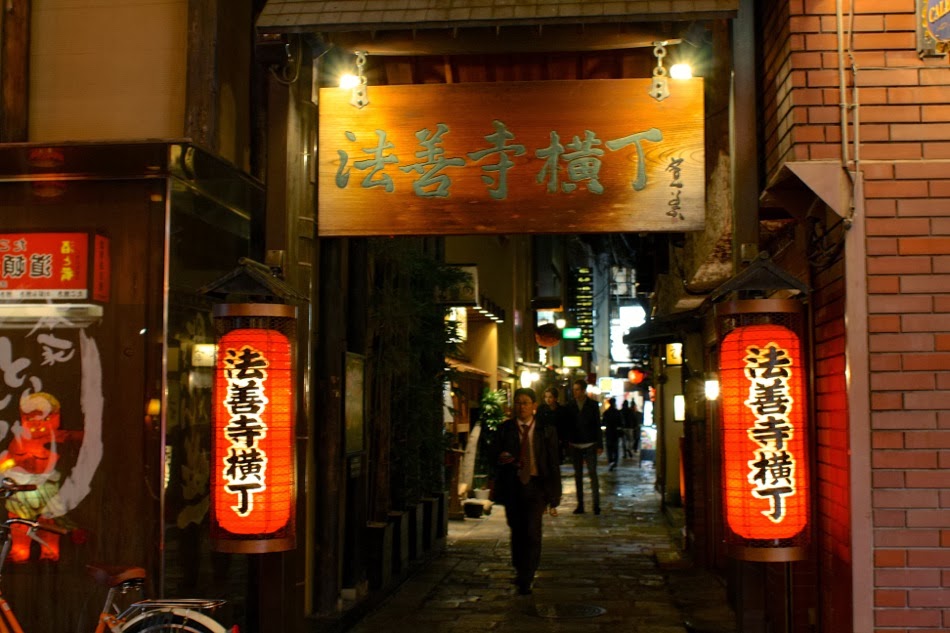
Note: Matsuzakagyu Yakiniku has 2 locations about a 3-min walk a apart. This location along Hozenji Yokocho has private rooms only; the other location is a dining room.


---
Matsuzakagyu Yakiniku
1-1-19, Namba
Chuo-ku, Osaka


2.02.2014

Off Dotonbori, a quieter Osaka

Dotonbori may symbolize what Osaka is all about in its extremities of visual appeal with colorful and neon lit 3D signboards of restaurants and stores along the street. If this colorful and animated madness ever gets too much for your mind to process, veer off Dotonbori even if literally for a few steps and you will find yourself in a vastly different atmosphere. Narrow brick-lined alleys with traditional Japanese restaurants and food shops give an olden days especially along Hozenji Yokocho. Here is Hozenji Temple, that offers a serene reflection where people occasionally stop by to pay homage and make prayer offerings.