Day 2
We woke up at 4:30am before sunrise and got ready for the day. We had coffee and rusks at 5:30am when the day was gradually getting a little brighter and we saw that we had awoken to hippopotamuses by the Sabie River. Our bungalow was directly facing the Sabie River where animals often came to drink water. The only thing that separated us from the wildlife and us when we went to sleep was the electric fence. To have such an up close experience with nature was surreal. We were on our way out of camp at 6:00am to begin the morning game drive in search of animals.


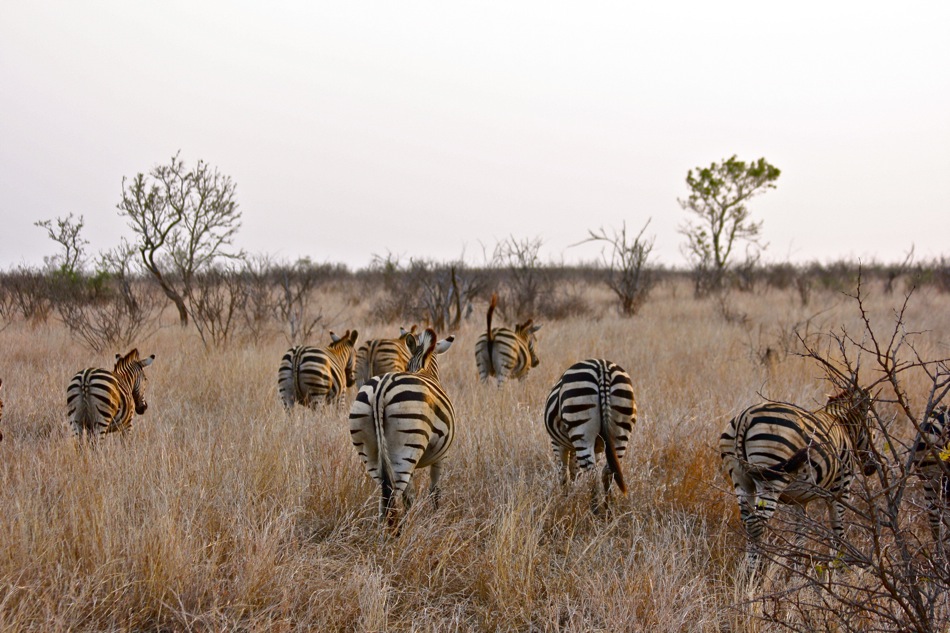
We did not spot any zebras the day before and today zebra sighting was high on our hopeful list. In general zebras prefer dry areas as their habitat and we drove to the southern area of Kruger for a better chance of spotting zebras. We were about 12km from the border of Mozambique when we had our first sighting of zebras. After that we got lucky again and repeatedly saw different big groups of zebras at different times of the day and at different areas of Kruger.


Wildebeests (Dutch for wild beast) are most commonly known for their Great Migration, an annual event when massive herds of them, up to more than a million, migrate across the areas of Serengeti in Tanzania and Masai Mara in Kenya. The Great Migration does not occur in South Africa but when the stomping sounds of wildebeests are heard, people mistakenly think (or maybe hope?) it's the great annual movement.


We saw a different herd of elephants, young and old, enjoying the cool and crisp morning having a playful time with each other and also eating the almost dried out leaves and twigs leftover from the previous winter season. Our particular favorite among this herd was the baby elephant who started showing off to us the moment his eye caught our presence. Almost approaching our open vehicle but not quite, it lifted its trunk and did some movements before going back to its mother. It was amazing.


Black rhinoceros is a very endangered species and Kruger has been taking steps to protect them from going extinct. Rhinoceros, both white and black, are endangered due to the illegal poaching of the animal just to get the horns for medicinal purposes used in the Far East. However, the black rhinoceros is extremely endangered compared to the white rhinoceros. There is an estimate of only about 2500 left in the Africa region where they can only be found. It is extremely rare to spot a black rhino today and clearly we were very lucky to have spotted one in solitary in the wild. Simon, our safari guide, has led safaris for about 10 years and spotting this black rhino was the highlight for him.

Hyenas were also spotted although they were quick to disappear when they detected any form of human presence around.

We gradually made our way back to camp at 10:00am when Simon made us a delicious brunch. We started with some muesli, yogurt, fruit, and milk and finished off with some very delicious English bacon, scrambled eggs, grilled tomatoes, mushrooms, and bread. A delicious meal called for a siesta and that was we did before heading out again for our afternoon game drive.


The day was getting a lot warmer and at a nearby waterhole, various wildlife came to get a drink water to cool off. The hippopotamuses, zebras, impalas, and elephants came as a group to the waterhole simultaneously while sticking together within its own type the entire time. Crocodiles were also spotted soaking themselves in the waterhole. Birds were resting on the hippopotamus' body above water. Watching this entire scene was incredible and we were almost at a lost of words to describe how amazing it was to see how different types of wildlife come together and form a perfectly balanced ecosystem in the wild. That is their universe. That is their world.


When this herd of elephants came to get a drink of water, they noticed the crocodile right next to them in the water and one of the elephants proceeded to use its trunk to spray water at the crocodile as a sign that it did not like the crocodile there. When drinking water, elephants use their trunk to suck up the water before putting the water into the mouth. Each time a trunk can suck up to 9 liters of water and each day an elephant can drink up to 100 liters of water.

To find out the length of a crocodile, the easiest way is to take the length of its head above water and multiply it by 6.

Male lions roar to mark their territory and the roars can travel up to 5 miles. This male lion was walking along with two other females. Unbeknownst to the lions, a group of impalas saw them from nearby and the impalas were immediately on full alert while silently keeping their eyes on the lions careful not to make a noise so they won't fall prey to the lions. It was an event of preys watching out for the predators.


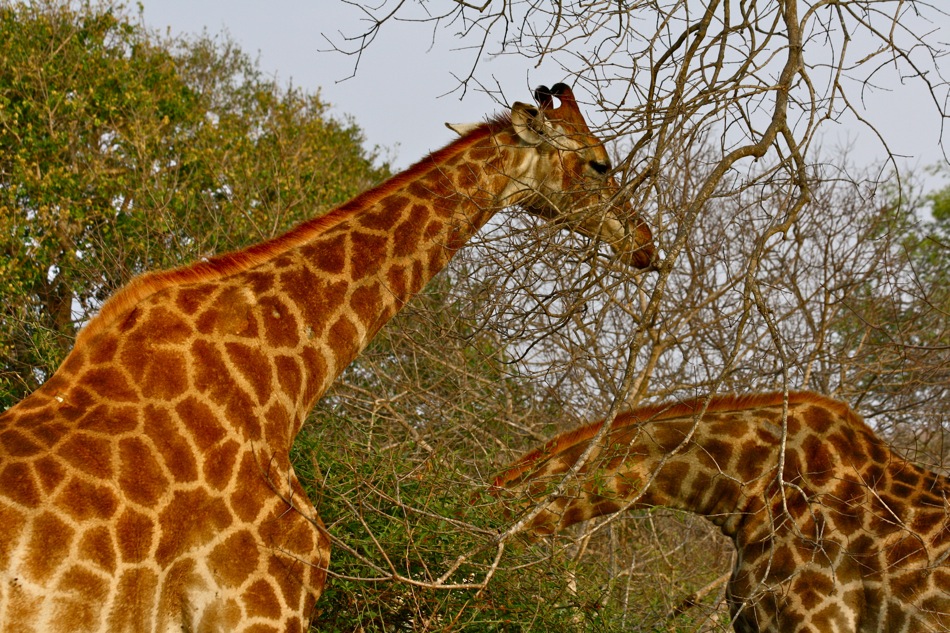
More giraffes were spotted on the game drive. Many of the giraffes we saw had wounds on their skin possibly from earlier struggles with other wildlife. It was not unusual to see birds resting on the giraffes as the birds tend to feed on animal wounds. Giraffes communicate at a very low frequency that is inaudible to human ears. During communication, giraffes can hear each other from up to 12km apart.


We spent the rest of day 2 looking out for cheetahs at another area in Kruger where they have been usually spotted but with no luck. Cheetahs like to lie on termite mounds for better elevation in order to watch out for prey.


Come sundown we returned to camp and had braai (South African barbeque) which included boerewors (South African sausage), steak, potatoes, bread, and salad. We ate outside our bungalow to the sounds and dark view of elephants snorting and picking at trees, with only the electric fence separating us and the animals.
Day 3
We woke up on day 3 not knowing that it was going to end with the ultimate highlight that we would remember for the rest of our lives.

But first, among the other animals we spotted was a different herd of elephants. This time we were in an area where the trees were in full bloom with fresh green leaves in springtime. Because of the huge size of an elephant, their skin would frequently get poked by thorns when walking through trees in the wild but this is part of life for them.


The elephants were contented eating away at the fresh leaves and it was striking to see how the animal has its own system of eating. The trunk functioned as a "hand" that plucked the leaves from the trees. Having grabbed the bunch of leaves, the trunk would shake off the bunch a little to remove access dirt or dried leaves, before using the trunk as the "hand" to put the leaves into the mouth.


And then the ultimate highlight began.
Two female lions had just completed a kill. While we did not witness the kill, we saw the lions eating away at its prey but we could not make out the animal that had fallen prey.


We were watching them closely as they were eating away. The lions then started walking away, one ahead of the other, and we followed along very quietly and slowly.


Just when we thought we could not get any closer (and we were already very close!), the lions unexpectedly came out from the bushes and came even closer to our open vehicle. The lions were unfazed by our presence and were literally walking side by side at arm's length next to us. We were tremendously awe struck and lost for words and all we could mouthed were whispers of, "Oh my gawd. This is amazing. Oh my gawd. I cannot believe this. Oh my gawd. This is beautiful. Oh my gawd." Our open vehicle crawled along with the lions walking next to us for about a minute although it felt longer than that. At times the lions turned and glanced at us but they were unfazed and kept walking. We quietly joked with one another and asked if anyone wanted to pee at a nearby bush.


The lions had blood stains on their body as evidence from their earlier kill and feast thereafter. The blood stains could be seen on their legs and neck. They were evidently full from the feast and then started to lay down and we continued admiring them.
Being at arm's length with two lions who had just completed a kill, I said to T "I am going to remember this for the rest of my life."
We left the safari that day feeling more than lucky to have witnessed and experienced so much up close.
Notes
*Kruger National Park is a malaria area so be sure to get a prescription of anti malaria pills from your primary care provider if you will be making a safari trip at Kruger.
*Insect repellent is recommended although we only ended up using a small amount of what we brought with us.
*We were there late spring/early summer and the weather was cold during the morning and evening game drives. However, during the day, the weather warmed up and it was a great time to be spent outdoors.